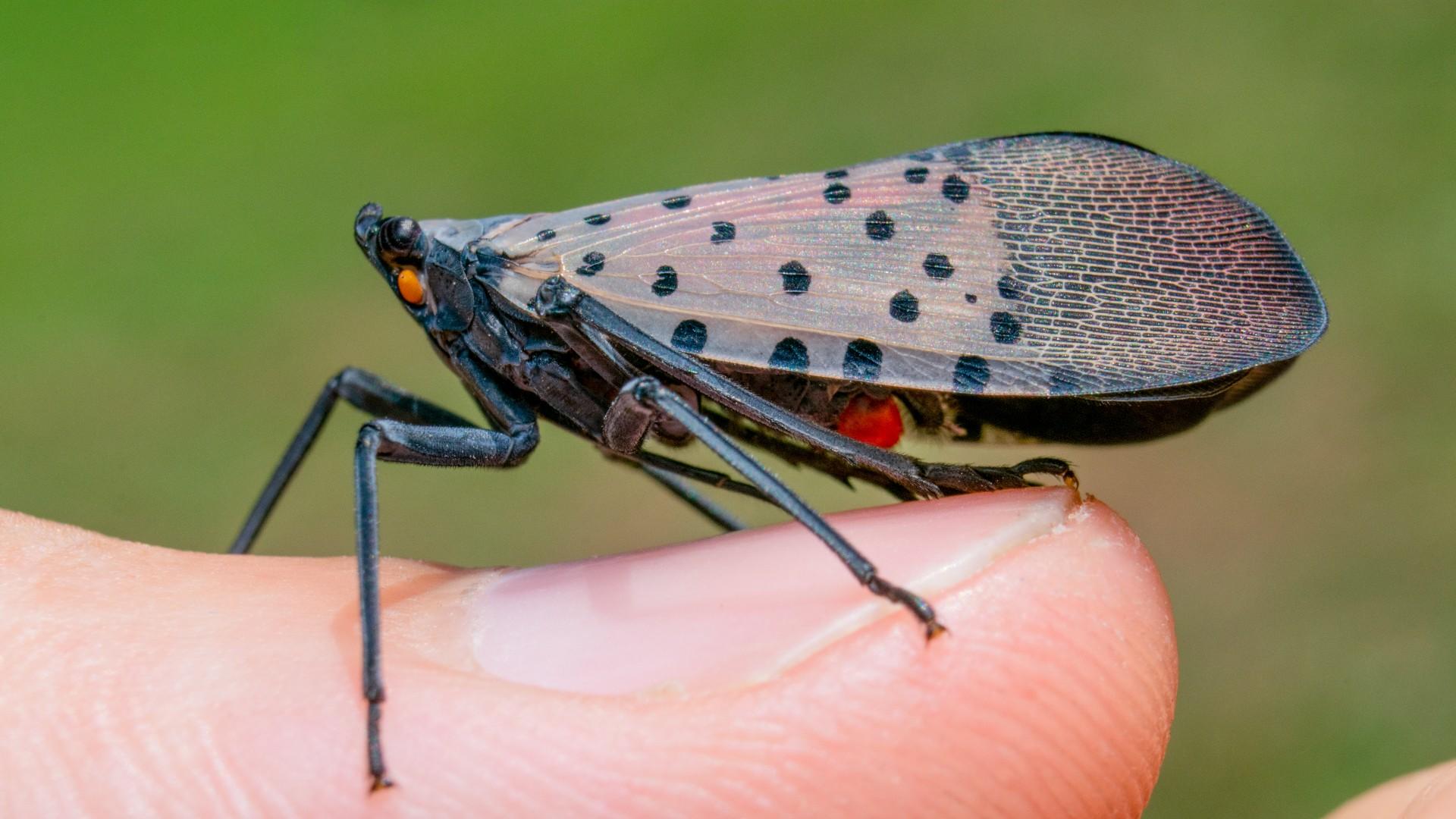
Spotted lanternfly (Lycorma delicatula). Photo: Peter L. Coffey, University of Maryland Extension (2017-2021)
Updated: April 2, 2026
Key points
Spotted lanternfly (Lycorma delicatula) is an invasive insect (planthopper) native to eastern Asia. It was first detected in the United States in 2014 in Berks County, Pennsylvania. In Maryland, it was first found in Cecil County in October 2018.
This pest does not bite or sting. Spotted lanternfly has piercing-sucking mouthparts and feeds on plant sap from a wide range of plants including grapes, hops, apples, stone fruits, maples, walnuts, and other plant species. Its feeding has not killed plants (except for grapes). It is primarily a threat to Maryland's agricultural crops.
All Maryland residents, from any county, are urged to report sightings of Spotted Lanternfly to the Maryland Department of Agriculture (MDA). This data is important for tracking phenology and population levels. Submit your reports through this online form. Questions or concerns about this pest also can be submitted to UMD Ask Extension, by email to DontBug.MD@maryland.gov, or call (410) 841-5920. Control information can be found at the bottom of this page.
The Secretary of Agriculture has issued a quarantine order for all 23 Maryland counties and Baltimore City. (View (PDF) Quarantine Map). Businesses and institutions are required to have a permitif they move regulated articles from or within the quarantined area. Further details about the quarantine zone and permit requirements can be found on the Maryland Department of Agriculture website.
Pause Before You Spray: Important Considerations
Spotted lanternfly is mainly a nuisance pest in residential gardens and landscapes and has not been shown to significantly damage otherwise healthy ornamental plants.
Spraying pesticides, including home remedies, can do more harm than good when it comes to spotted lanternfly in residential greenspaces. Any chemicals can potentially harm pollinators and beneficial insects.
Consider more sustainable management options or leaving spotted lanternflies for predators to feed on.
Be aware of spreading inaccurate information and sensationalized media.
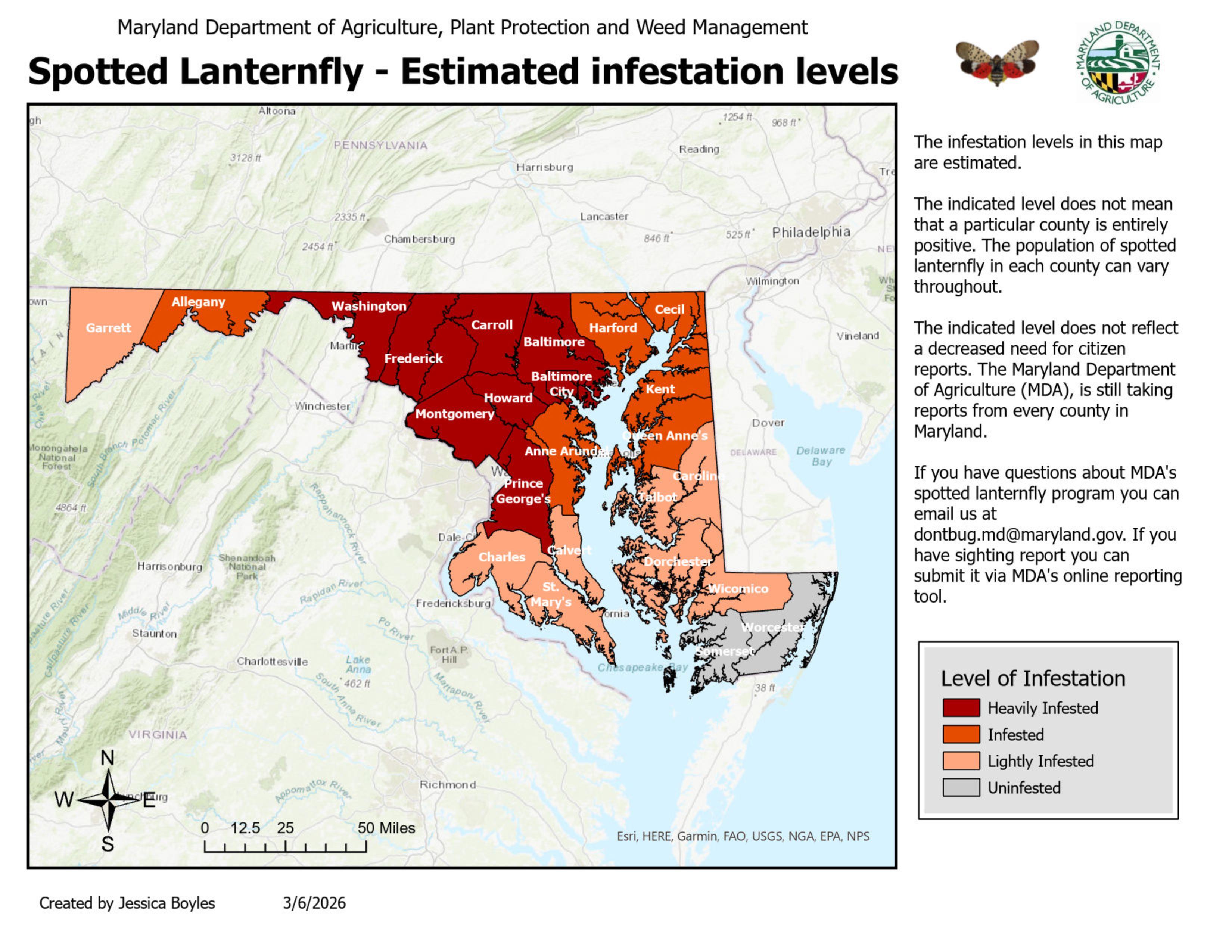
Relative abundance of spotted lanternfly across Maryland
In the following MDA map, Maryland counties are ranked by the estimated spotted lanternfly (SLF) population abundance as of March 2026. Baltimore City and the central counties (Baltimore, Howard, Prince George's, Montgomery, Carroll, Frederick, and Washington) are the most heavily infested areas, indicated by dark red shading. Moderate levels of infestation (orange shading) occur in Allegany, Harford, Cecil, Kent, Queen Anne's, and Anne Arundel counties. Light infestations occur in Garrett, Caroline, Talbot, Dorchester, Wicomico, Calvert, Charles, and St. Mary's counties (light orange shading). Infestations have not yet been noted in Worcester and Somerset counties (gray shading).
The infestation levels are estimated and do not mean that a particular county is uniformly positive: SLF populations can vary throughout a county. The infestation level does not reflect a decreased need for resident reports. The MDA is still taking reports from every Maryland county and city. (Source: Jessica Boyles, MDA Spotted Lanternfly Program, March 6, 2026.)
A color-coded map of relative spotted lanternfly abundance across Maryland counties and Baltimore city, as of March 2026. Graphic: Maryland Department of Agriculture Plant Protection and Weed Management section.
Behavior of spotted lanternfly
Spotted lanternfly is a type of planthopper insect that feeds in large groups on a wide range of plants including grapes, peaches, apples, walnuts, oaks, and pines. They do not bite or sting people or pets.
Red oak leaves with honeydew from spotted lanternfly feeding. Photo: Lawrence Barringer, Pennsylvania Department of Agriculture, Bugwood.org
Both adults and nymphs (immatures) feed by sucking sap (phloem) from plant stems and trunks. During feeding, they produce a sugary waste substance called honeydew. Honeydew can accumulate and stick to understory plants as well as objects. This sugary substance can attract other pests and support the growth of sooty mold, which can contaminate and reduce the value of fruits, reduce plant photosynthesis, and weaken overall plant health. Wasps may be attracted to honeydew, and caution should be used if a spotted lanternfly-infested plant is in a high-traffic area. For more information on wasps, please see our social wasps page.
Tree-of-heaven (Ailanthus altissima) Photo: Richard Gardner, Bugwood.org
A primary host plant for the spotted lanternfly istree-of-heaven (Ailanthus altissima), an invasive weedy tree that grows in disturbed areas on field edges and roadsides. Early research suggests that spotted lanternfly may prefer to feed and reproduce on tree-of-heaven, but research has also shown that it can complete its life cycle on a wide range of other plant species. Refer to our information about tree-of-heaven and how to remove it.
Current distribution & map of spotted lanternfly locations
Spotted lanternfly was first discovered in Berks County, Pennsylvania in 2014. A shipment of stone imported from Asia was contaminated with spotted lanternfly egg masses. Despite quarantine efforts, spotted lanternfly became established and continued to spread throughout southeastern Pennsylvania. It is now moving into nearby states including Maryland, Virginia, Delaware, and New Jersey.
Based on climate data, most of the eastern half of the United States as well as California, Washington, and Oregon have suitable conditions for spotted lanternflies to expand their range. Refer to Lanternflies on the Move by University of Maryland by Professor Emeritus Dr. Michael Raupp.
The life stages of spotted lanternfly
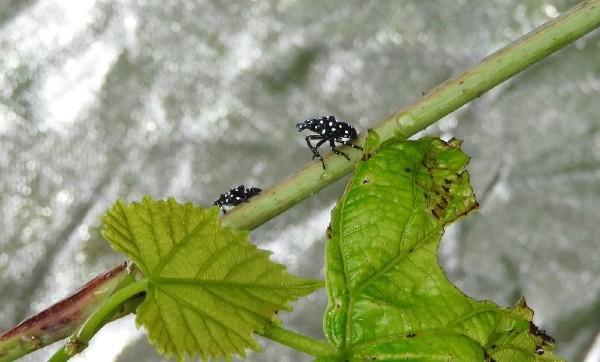
Spotted lanternfly nymphs (immature form) resemble large black aphids with white spots. There are three instars (phases) of these early-stage nymphs and they are usually found from April-July.
First-instar spotted lanternfly nymphs: black bodies with white spots. Photo: Richard Gardner, Bugwood.org
Later-stage nymphs (fourth instar) are red with white spots. These are typically found from July-September.
Fourth-instar spotted lanternfly nymph: red body with black and white spots. Photo: Peter L. Coffey, University of Maryland Extension
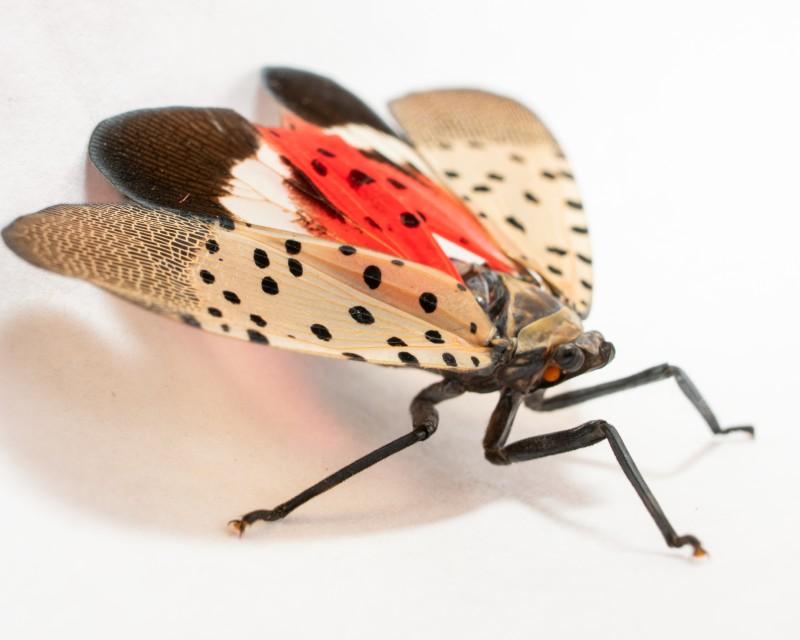
Spotted lanternfly adults may be present from July through early November. The outer wings are grey with black spots and have a brick-like pattern at the wing tips. The hidden underwings have brightly contrasting large patches of red, black, and white. The legs and head are black. The abdomen has broad black bands, with yellow on the sides.
Spotted lanternfly adult. The red, black, and white pattern visible on flared hind wings is hidden when the insect is resting with wings held over its back. Photo: Peter L. Coffey, University of Maryland Extension
Spotted lanternfly eggs are laid in masses containing 30 to 50 individual eggs that will overwinter and hatch in the spring. Females will lay eggs on any flat vertical surface, including trees, stones, vehicles, grills, and outdoor furniture.
Fresh egg masses can be found from September-December. They are about one inch long and have a grey mud-like covering which cracks over time as it dries out. The covering eventually flakes off revealing 30 to 50 brown eggs which resemble seeds set in 4 to 7 rows. Depending on where the egg mass is laid, the egg mass may be well hidden.
Several spotted lanternfly egg masses at the base of a tree. Photo: MDA Spotted Lanternfly ProgramAn egg mass and nymphs. Photo: MDA Spotted Lanternfly ProgramSpotted lanternfly eggs on tree bark. This egg mass is not covered with the clay-like coating typical of most egg masses. Photo: Lawrence Barringer, Pennsylvania Department of Agriculture, Bugwood.org
Life cycle timeline
Calendar illustration showing the approximate times of year each SLF life stage will be present. Nymphs hatch in April and May and reach adulthood by late summer.
Nymphs hatch out of eggs in April and develop through several instars (the stages between molts) midsummer. They mature into adulthood in late summer. After mating, adult females will lay eggs throughout the fall. All adult lanternflies will die by the start of winter. Egg masses will last through winter and hatch the following spring.
The pace of insect development, including the timing of overwintering egg hatch, is determined largely by temperature. The National Phenology Network (NPN) generates a map of the contiguous U.S. that predicts egg hatch and adult emergence each year based on recent weather and temperature trend forecasts:
Prevent the spread of spotted lanternfly by inspecting your vehicle and any outdoor equipment (grills, mowers, camping supplies, firewood, etc.) when traveling in and out of the quarantine zones in Maryland, Pennsylvania, Ohio, Virginia, Delaware, New Jersey, and Connecticut. Refer to this (PDF) checklist to inspect for spotted lanternfly.
Businesses and institutions are required to have a permit if they move regulated articles from or within the quarantined area. Further details about the quarantine zone and permit requirements can be found on the Maryland Department of Agriculture website.
Manage spotted lanternfly around your home
What to do if you find spotted lanternflies in Maryland
Residents of Maryland are urged to report observations of SLF to the Maryland Department of Agriculture (MDA). Submit your report to the MDA online. Questions or concerns about this pest also may be sent by email to DontBug.MD@maryland.gov or call (410) 841-5920.
Don't panic -- Spotted lanternflies are a nuisance pest in home landscapes. They do not bite or sting people or pets, they do not chew leaves, and they are not wood-boring pests of homes or other structures. They do not kill trees but can cause stress on them, so best management practices in the way of water management, soil health, and correct mulching will go far to help keep your plants healthy.
In residential yards and gardens, the recommended approach is to physically kill any spotted lanternflies that are safely reachable or to leave spotted lanternflies for predators to feed on. Insecticide and other chemicals can harm non-target animals including pollinators and beneficial insects and will not effectively reach and kill all of the spotted lanternflies that are present and on the move. SLF is not harming landscape or garden plants enough to justify the risks of using insecticidal sprays. Do not spray home remedies such as white vinegar or dish soap because these items can harm other animals and plants.
Place exclusive netting with fine mesh over vulnerable plants like grape vines, tightly securing the sides and bottom of the netting. Spotted lanternfly may feed on any plant stems in direct contact with the netting. It is important to note netting could increase disease pressure under certain environmental conditions.
Mechanical (non-chemical) control
Knock spotted lanternflies off of plants with strong water sprays or by hand into a container of soapy water.
Destroy spotted lanternfly adults and nymphs by crushing them with gloved hands, stomping on them by shoed feet, smashing them with fly swatters or rackets, or placing them in a container of soapy water or rubbing alcohol (isopropyl alcohol).
Scrape egg masses off woody plant bark and hard surfaces such as lawn furniture, decks, and concrete surfaces using a plastic card or tool such as a putty knife. The eggs must then be crushed in order to kill them. Eggs can be crushed with gloved hands or dropped into a container of rubbing alcohol or hand sanitizer. Be sure you confirm the identity of the egg mass before destroying it. There are many beneficial insects that lay egg masses on bark and other hard surfaces.
Adhesive (sticky) traps can be placed on trees but should be used in combination with a screen cover to prevent by-catch of birds, squirrels, beneficial insects, and other animals.
Use a shop vacuum to suck up SLF, then destroy and discard them.
Biological control
Natural enemies include spiders, praying mantids, assassin bugs, predatory stink bugs, and birds. Support a healthy environment for natural predators by reducing pesticide use and growing a variety of flowering plants and plant types in your landscape. Plant diversity provides food and habitat for natural enemies.
Research is underway on biological control options such as entomopathogenic (insect-killing) fungi. Beauveria bassiana is a fungus that will cause a disease in SLF. It is commercially available but it is not practical to use in home gardens effectively. Furthermore, it is not specific to SLF and can have negative effects on non-target insects.
Research on the use of certain parasitic wasp species, like egg parasitoid Anastatus orientalis and nymphal parasitoid Dryinus sinicus, for biological control of SLF is underway.
Chemical control
Spotted lanternflies are constantly on the move. Spot-spraying and whole-yard insecticide treatments will only put a small, temporary dent in the population while also potentially harming animals such as beneficial insects. Insecticidal soap and neem oil are effective only if they are applied directly to spotted lanternflies and the surfaces on which they are feeding and walking. Neem oil and insecticidal soap have a short period of residual activity and would need to be re-applied at intervals recommended on the product label.
We do not recommend spraying pyrethroid insecticides because they are non-selective and can harm non-target insects like pollinators
Do not apply insecticides on lawns to control spotted lanternflies. Spotted lanternflies do not live in lawns.
You are required by law to apply pesticides according to the directions on the label. This increases your safety, the safety of the environment, and the effectiveness of the pesticide. Home remedies may be harmful to people, pets, and/or plants and should not be used as pesticides.
Avoid using homemade remedies against spotted lanternflies. Homemade solutions are not tested and not science-based and could harm humans, pets, other animals, and plants.
Reminder: Neonicotinoids (a group of pesticides) like Dinotefuran cannot be applied by home gardeners in the state of Maryland (Maryland Pollinator Protection Act of 2016). Only farmers and certified pesticide applicators (or people under their supervision) can apply neonicotinoid pesticides outdoors. Be aware that neonicotinoid products can be found on Maryland store shelves. Be sure you know what you are buying and spraying.
Video: Spotted Lanternfly Identification and Life Cycle, Penn State University
Revised by Madeline Potter, Faculty Specialist, Entomology/IPM, University of Maryland Extension, 03/2026. Previous contributors/co-authors: Christa Carignan, Horticulturist and Coordinator; Peter Coffey, Agricultural Science Agent Associate (2017-2021); Emily Zobel, Senior Agent Associate, University of Maryland Extension.