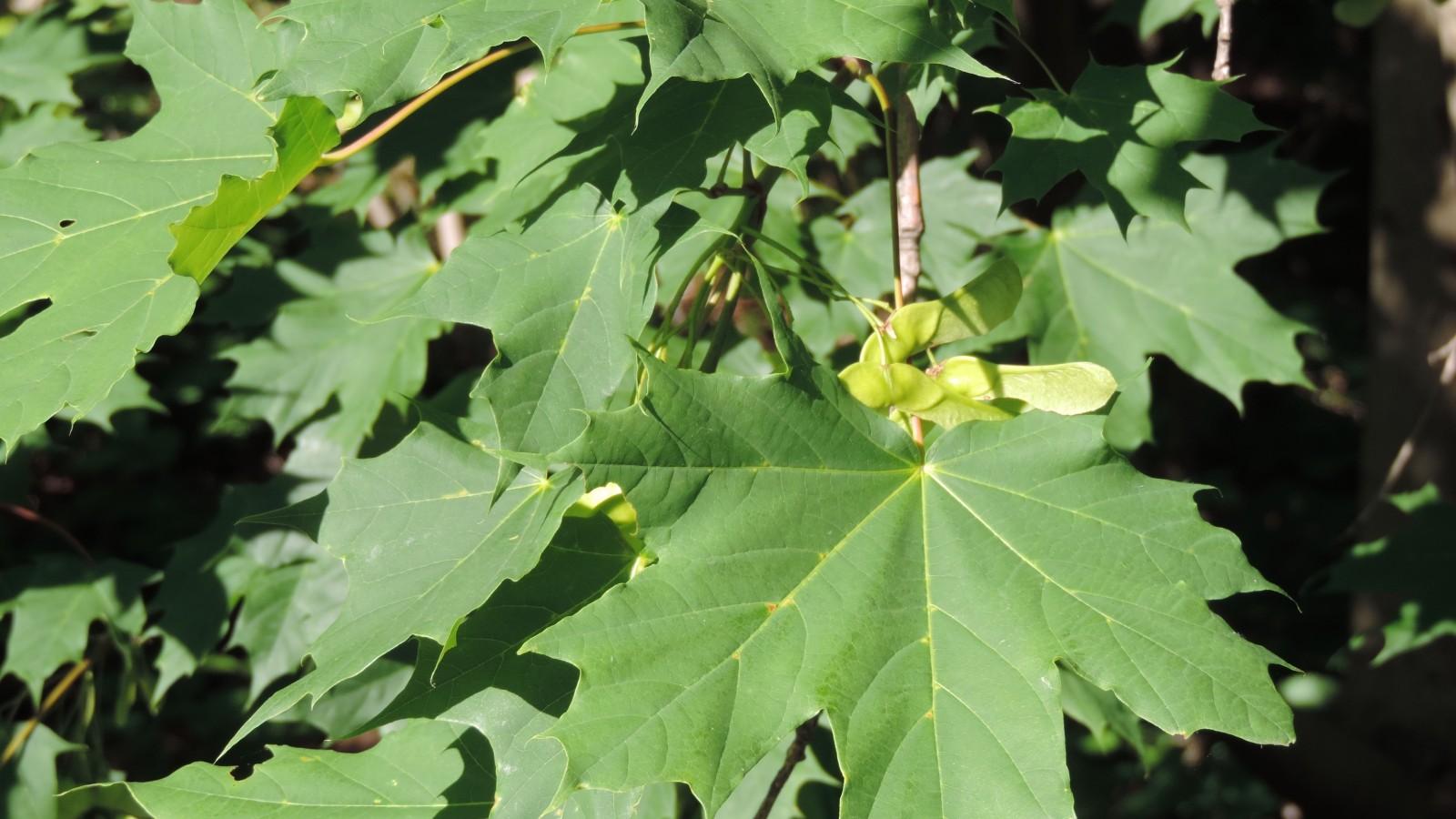
Norway maple (Acer platanoides) leaves and seed cluster. Photo: Richard Gardner, Bugwood.org
Updated: April 28, 2026
Norway maple (Acer platanoides) is a flowering tree native to Eurasia. It was introduced to the U.S. in the mid-1700s as an ornamental shade tree because of its fast growth and tolerance of poor soil and air pollution. In some communities, it was planted heavily when American elms were weakened and killed by Dutch Elm Disease.
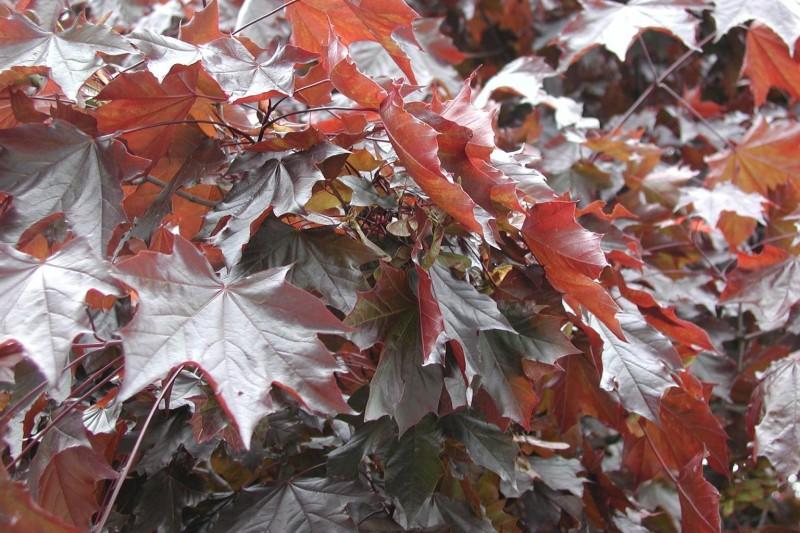
Several cultivars exist; 'Crimson King' has been a widely-planted form with dark purple leaves.
Physical features of Norway maple
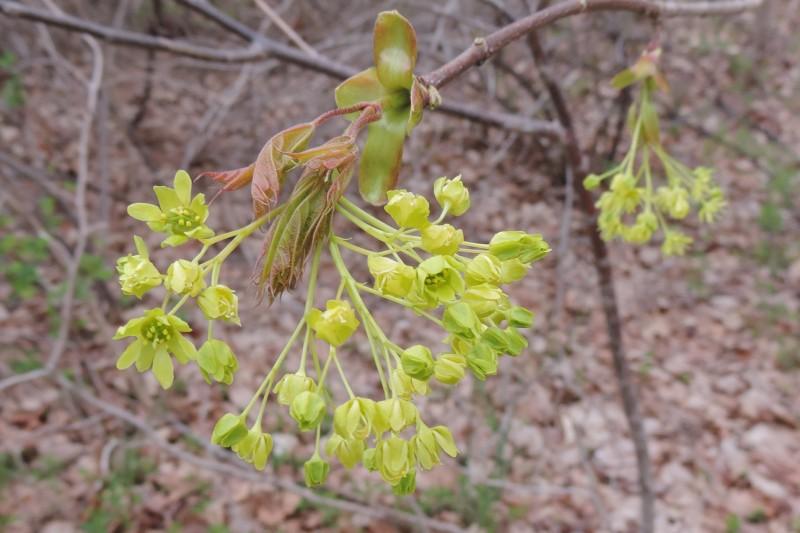
Norway maple is a medium- to large-sized deciduous tree (sheds its leaves in autumn). It blooms in mid-spring before its leaves have fully expanded.
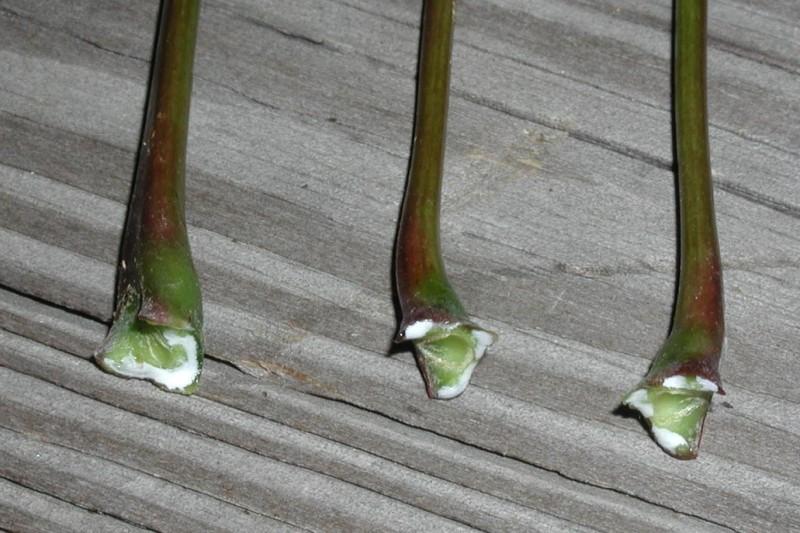
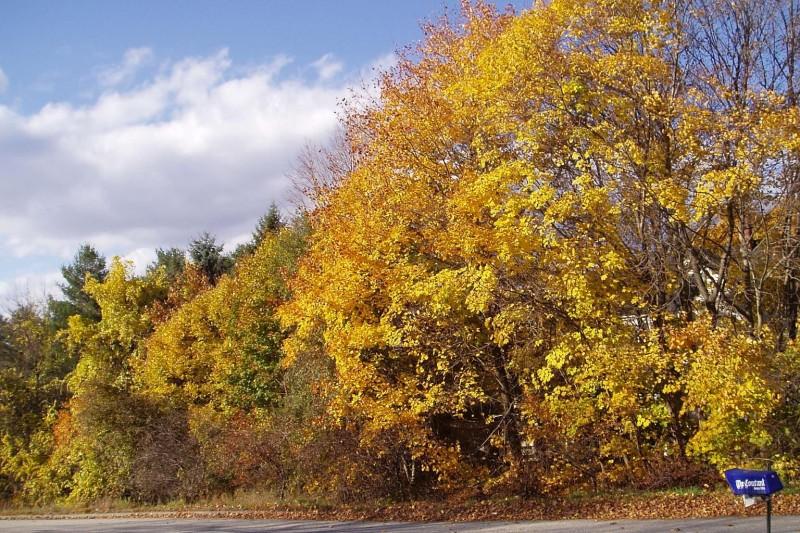
The size and shape of its leaves can be confused with sugar maple (and the less-well-known black maple). Norway maple leaves turn yellow in autumn, while sugar maple leaves tend to be more orange. During the growing season, Norway maples can be distinguished from other maples by the white milky sap that exudes when a leaf petiole (stem) is detached from the tree; this feature may be more prominent early in the growing season.
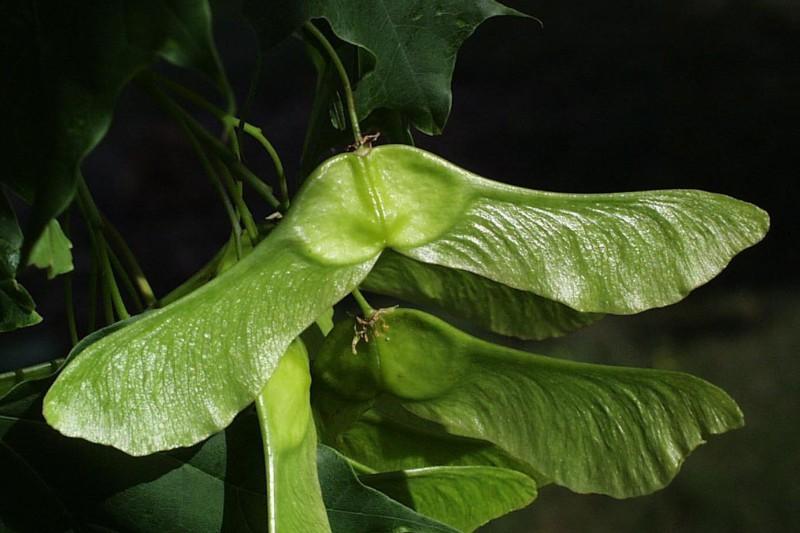
Large, papery wings attached to the seeds make them spin as they fall, giving them a common name of "helicopter" seeds. (This type of winged seed is termed a samara.) Norway maple's nearly 180-degree angle formed by the two wings is very wide among other Maryland maples. The angle separating seed wings is about 90 degrees or less in sugar maple. Norway maple seeds are also quite flattened, compared to more spherical in sugar maple. Norway maple samaras mature in early to mid-autumn and often remain on the tree into winter.
Growth rate and habit: moderate to rapid growth rate (over 1 foot per year); canopy rounded to somewhat broad
Typical mature size: 40 to 50 feet tall (potentially up to 90 feet) and 30 to 50 feet wide
Blooms: clusters of long-stalked greenish-yellow flowers
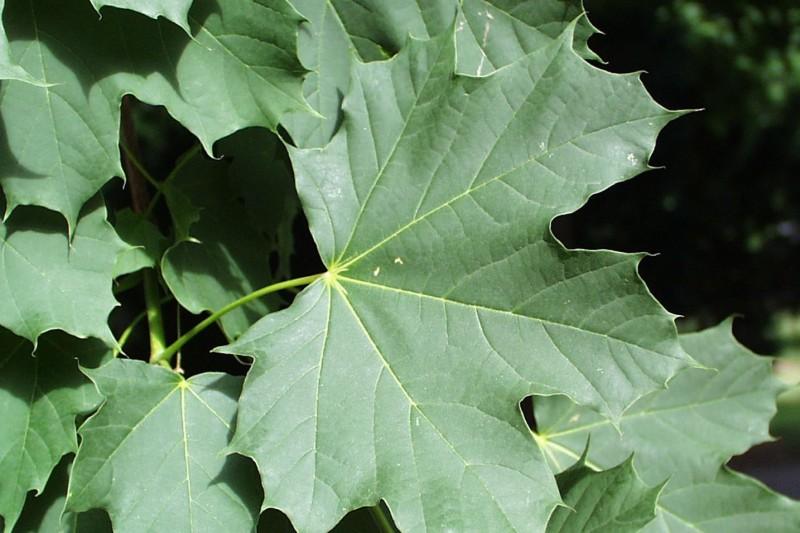
Leaves: simple (not divided into leaflets) with 5 to 7 primary, pointed lobes; wider than long in overall size; opposite arrangement on the stems
Seeds: hanging, long-stalked, pale green clusters; individual seeds are attached to each other in pairs, with large wings spread apart at a wide angle
Greenish-yellow flower clusters open before the leaves have expanded on Norway maple twigs. Photo: Richard Gardner, Bugwood.org
Ripening Norway maple seeds (samaras) with the characteristically wide angle between the wings. Photo: Paul Wray, Iowa State University, Bugwood.org
White sap oozes from the stem (petiole) of freshly-removed Norway maple leaves. Photo: Leslie J. Mehrhoff, University of Connecticut, Bugwood.org
Yellow autumn leaves on Norway maple trees growing along the edge of a forest. Photo: Leslie J. Mehrhoff, University of Connecticut, Bugwood.org
Norway maple leaves are wider than long and have 5 or 7 pointed lobes. Photo: Paul Wray, Iowa State University, Bugwood.org
Norway maple cultivars with dark reddish-purple leaves have been widely planted. Photo: Leslie J. Mehrhoff, University of Connecticut, Bugwood.org
Environmental impacts of Norway maple
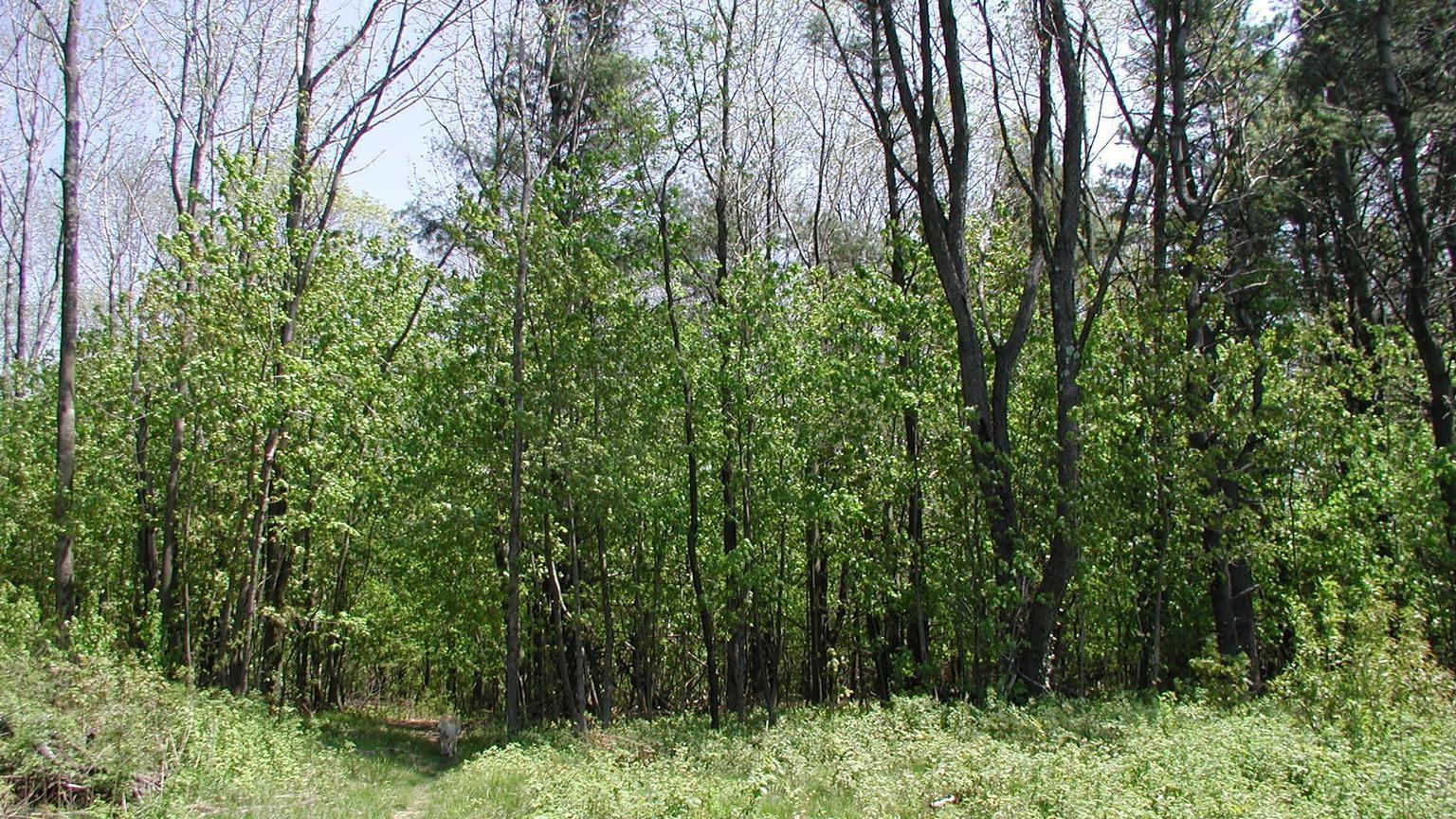
Norway maple is an invasive species whose seeds are dispersed primarily by wind. The dense shade of mature Norway maple trees reduces light availability for forest understory plants. The competitive, shallow root system alters nutrient availability and impedes the growth of other species, resulting in lower plant diversity.
Norway maple saplings can take over a forest understory, and their early spring leaf emergence deprives native forest floor plants of enough light. Photo: Leslie J. Mehrhoff, University of Connecticut, Bugwood.org
Conditions that favor growth
Norway maple is tolerant of a wide variety of light and soil conditions; cultivated trees prefer full sun and handle urban stress (such as compacted soil and street tree use) well. Seedlings can establish quickly in deciduous forests.
Alternatives to Norway maple
Do not plant Norway maple, and replace existing specimens when possible. The Maryland Department of Agriculture (MDA) regulates the sale of invasive plants and conducts invasive plant species status assessments. Norway maple is on a list of species prioritized for assessment. Refer to the MDA's Maryland Prohibited Invasive Plant Law and Regulations resource page for more information and a list of regulated species.
Seven species of maple (genus Acer) are native to Maryland. The leaves of sugar maple (Acer saccharum) and black maple (Acer nigrum) look the most like Norway maple in shape. The most widely cultivated native maple with widespread distribution across the state is red maple (Acer rubrum).
Several other native or non-invasive trees have rapid growth or cast dense shade. Candidates include river birch (Betula nigra), tulip poplar (Liriodendron tulipifera), and Southern magnolia (Magnolia grandiflora).
Dirr, Michael A. 2009. Manual of Woody Landscape Plants: Their Identification, Ornamental Characteristics, Culture, Propagation and Uses, Sixth Edition.
Kaufman, Sylvan Ramsey & Wallace Kaufman. 2007. Invasive Plants: Guide to Identification and the Impacts and Control of Common North American Species.
Sarver, Matthew, Amanda Treher, Lenny Wilson, Robert Naczi, Faith B. Keuhn. 2008. Mistaken Identity? Invasive Plants and Their Native Look-alikes. Delaware Department of Agriculture.
(PDF) Plant Invaders of Mid-Atlantic Natural Areas Swearingen J., B. Slattery, K. Reshetiloff, and S. Zwicker. 2010. Plant Invaders of Mid-Atlantic Natural Areas, 4th ed. National Park Service and U.S. Fish & Wildlife Service, Washington, DC. 168pp.